





Radon: Guidance on protective measures for new buildings BR 211
BRE (Building Research Establishment) is an independent, research-based consultancy, testing and training organisation, operating in the built environment and associated industries.
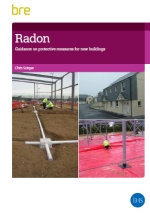
On 6 November 2015, BRE published Radon: Guidance on protective measures for new buildings (BR 211- 2015 edition), written by Chris Scivyer.
Approved document C, Site preparation and resistance to contaminants and moisture, describes radon as:
| …a naturally occurring radioactive colourless and odourless gas which is formed in small quantities by radioactive decay wherever uranium and radium are found. It can move through the subsoil and so into buildings. Some parts of the country, notably the West Country, have higher levels than elsewhere. Exposure to high levels for long periods increases the risk of developing lung cancer. To reduce this risk all new buildings, extensions and conversions, whether residential or non-domestic, built in areas where there may be elevated radon emissions, may need to incorporate precautions against radon. |
BR 211 provides guidance for reducing the concentration of radon in new buildings, extensions, conversions, and refurbishment projects, and so reducing the risk of occupants being exposed to it. It is intended for use in England, Wales, Scotland and Northern Ireland, and supports building regulations for England, Wales and Northern Ireland, and building standards for Scotland.
It was originally published in 1991 and was subsequently amended in 1992, 1999 and 2007. The 2015 edition replaces previous editions and two earlier guidance documents:
- BRE Report BR 376, Radon: guidance on protective measures for new dwellings in Scotland, introduced in 1999.
- BRE Report BR 413, Radon: guidance on protective measures for new dwellings in Northern Ireland, introduced in 2001.
Its contents are:
- Introduction.
- National building regulation guidance.
- Protective measures.
- Determining the level of protection.
- Protective measures: technical approach.
- Detailed protective measures.
- References and further reading.
- Appendix A: Maps of areas where basic or full protection should be provided.
- Appendix B: Radon protective measures quality management checklist.
[edit] Find out more
[edit] Related articles on Designing Buildings Wiki
- Approved Document C.
- BRE articles on Designing Buildings Wiki.
- BRE Buzz articles on Designing Buildings Wiki.
- Brownfield land.
- Building on fill.
- Building Research Establishment BRE.
- Contaminated land.
- Cover systems for land regeneration - thickness of cover systems for contaminated land (BR465).
- Deleterious materials.
- Ground conditions.
- Landfill tax.
- Methane and other gasses from the ground.
- Pollution.
- Radon.
- Radon protection for new domestic extensions and conservatories with solid concrete ground floors (GG 73 revised).
- Radon protection for new dwellings GG 74.
- Radon protection for new large buildings GG 75.
- Radon solutions in older homes GR 38.
- Site appraisal.
- Site investigation.
- Soil survey.
- Solid and liquid contaminants risk assessments.
Featured articles
Check out some of the best features and news from Designing Buildings as well as key stories from around the web.

CIOB celebrates positive Ofsted report.

The Building Safety Regulator announces a call for evidence.

Government approach could undermine delivery and regeneration.
World's first mass timber data centre.

The overlooked environmental aspect of data centre development.
Introduction to radon awareness

New technical information sheet published by CIOB.

Updated supplier guide can help electrical contractors engage with NHP.

CIAT confirm the winners of the 2026 architectural technology awards.

Government launches a one stop shop for flood preparedness.

Sir Edwin Lutyens: Britain's greatest architect? Book review.

CIOB publishes free template to help assess and manage risks.
ECA's reflections on Party Conference season

Burnham wants to be confident of winning before asking for a fresh mandate.
New Chief Construction and Scientific Adviser

Sergio Cavalaro, Professor of Infrastructure Systems at Loughborough University.